
When you think about the smelliest animal out there, skunks probably pop into your head right away. Their spray is legendary—it can absolutely ruin your day in just a few seconds.
But here’s the thing: skunks aren’t actually the smelliest creatures on Earth. Some animals have odors that are, honestly, even worse.

You might not expect it, but animals like the stinkbird or the sea hare have their own wild ways of weaponizing stink. These smells help them dodge predators, just like a skunk’s spray does.
When you start looking into how animals use stink, you realize skunks are up there—but they don’t totally win the “smelliest” award.
Curious about which animals actually take the top spot for bad smells? And why do skunks still get so much attention? Let’s wander into the weird world of nature’s stinkiest creatures.
Why Skunks Are Considered the Smelliest Animal

Skunks have a powerful smell that people can pick up from a long way off. That scent protects them from danger, and honestly, it’s pretty unique among animals.
Let’s get into what’s actually in that spray, how skunks use it to survive, which skunk species are the worst offenders, and what you can do if you end up on the wrong side of a skunk’s aim.
Potency and Chemistry of Skunk Odor
A skunk’s spray comes packed with sulfur-based chemicals called thiols. These are the real culprits behind that sharp, nose-burning smell.
Some of the main thiols in skunk spray are butanethiol and 3-methyl-1-butanethiol. They stick around for days—sometimes longer than you’d like.
When a skunk lets loose, those chemicals evaporate super fast and drift through the air. Oxygen in the air can make the odor even worse by turning the thiols into acids.
Because this chemical cocktail is so strong, people often call skunks the smelliest animal on Earth. Is that fair? Maybe, maybe not—but it’s hard to argue after you’ve smelled it.
How Skunks Use Their Scent for Survival
Skunks don’t spray for fun. They use their musk mostly to scare off predators—think coyotes, foxes, dogs, the usual suspects.
Before spraying, a skunk tries to warn you. It’ll stomp its feet, hiss, and flick its tail, kind of like it’s saying, “Back off, or else.”
If you don’t listen, the skunk can spray its foul scent up to 10 feet—sometimes with alarming accuracy. The smell can make animals cough, gag, or even lose their vision for a bit, giving the skunk a chance to bolt.
Animals quickly learn to avoid skunks after one bad experience. That’s probably why you see skunks thriving in both forests and neighborhoods.
The Striped Skunk and Other Members of Mephitidae
The striped skunk (Mephitis mephitis) is the most common—and, honestly, the smelliest—species. You know the one: black fur, big white stripes, and an attitude.
Other members of the Mephitidae family, like polecats and spotted skunks, have their own smells. But their odors usually aren’t quite as intense.
Striped skunks pack the most powerful punch because their musk is loaded with the stinkiest thiols. That’s what keeps them safe, even when predators get curious.
Methods for Removing Skunk Odor
If a skunk sprays you or your pet, you’ll want to act fast. The classic fix is a mix of hydrogen peroxide, baking soda, and dish soap. This combo breaks down those stubborn sulfur chemicals and helps kill the smell.
Some folks try tomato juice, but that usually just covers up the odor for a bit. It doesn’t really solve the problem.
You can also find commercial skunk odor removers—they’re made just for this kind of disaster.
Whatever you use, wash up quickly and rinse well. Skunk spray can irritate your skin and eyes, so it’s best to clean up before it gets worse. For more tips, check out this guide on skunk odor removal.
Comparing Skunks to Other Smelliest Animals in the Animal Kingdom
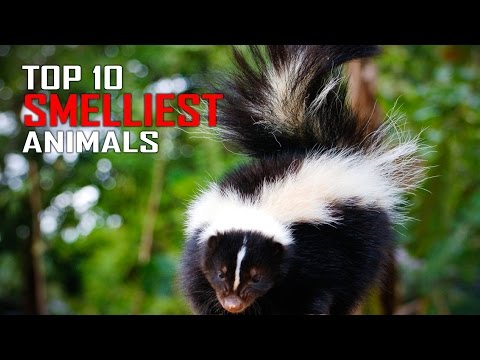
Skunks come to mind first when you think about smelly animals. But honestly, some creatures can rival—or even beat—a skunk’s stink.
These animals use their own intense smells to keep predators away or mark their turf. You’ll find mammals, insects, birds—all sorts—using stink as their secret weapon.
Contenders: Wolverine, Tamandua, and Striped Polecat
Wolverines are tough, and they’ve got a smell to match. People even call them the “skunk bear” because their scent is that bad.
The tamandua, or lesser anteater, lives in South and Central America. Some say its odor is up to seven times stronger than a skunk’s! That’s wild. It uses the smell to keep predators away, along with those fierce claws.
The striped polecat is another contender. It looks a lot like a skunk but lives in Africa. Its spray is so intense, it can temporarily blind whatever’s unlucky enough to get hit.
Unlike most animals that just mark with urine, striped polecats use both feces and their powerful spray to lay down boundaries. That’s commitment.
Musk Ox, Bombardier Beetle, Hoatzin, and Tasmanian Devil
The musk ox lives in cold places like Alaska. It’s a big, shaggy mammal, and when mating season rolls around, the males put out a musky odor that most people would probably call unpleasant.
Honestly, that smell could clear a room, but it works for attracting mates.
The bombardier beetle is this tiny insect with a wild defense trick. If something threatens it, the beetle blasts out a boiling chemical that smells terrible and burns if you touch it.
It’s not the same as skunk spray, but predators definitely get the message to stay away.
Then there’s the hoatzin—or as some folks call it, the stinkbird. This bird smells a lot like manure because of its weird digestive system.
Predators usually avoid it, but let’s be real, nobody’s lining up to eat a bird that smells like a barnyard.
And the Tasmanian devil? It’s from Australia and has its own nasty-smelling gas to keep threats at bay.
Maybe it’s not as legendary as a skunk, but if you get close, you’ll remember that stench.


