
Ever catch yourself wondering if chimpanzees might eventually turn into humans? It’s a pretty common question, and honestly, it makes sense—chimps seem so much like us in a lot of ways. But let’s clear this up: chimpanzees aren’t about to become humans, not now, not ever.

Humans and chimpanzees actually share a common ancestor from millions of years back. Each species has wandered off on its own evolutionary journey since then.
So, they’ve been evolving separately for ages. Neither is on a path that leads straight to the other.
This way of looking at things helps you realize how evolution really works. It’s not a ladder with humans at the top—it’s more like a tree, with branches twisting off in all sorts of directions.
The story here isn’t about one species morphing into another. It’s about life changing in all kinds of ways, over time. If you’re curious, there’s a lot of good info on the chimpanzee-human last common ancestor.
The Evolutionary Relationship Between Chimpanzees and Humans

So, how are chimpanzees and humans connected? Why do they seem so different now, even though they came from the same roots?
It all boils down to your shared spot in the ape family tree, the traits passed down from those old ancestors, and the way species like bonobos and chimps have changed compared to humans.
Understanding Human Evolution and the Evolutionary Tree
Humans belong to the great apes, along with chimpanzees, bonobos, gorillas, and orangutans. The evolutionary tree shows which species share branches and when those branches split.
Humans and chimpanzees split from a common branch about 6 or 7 million years ago. That’s a long time to go your separate ways.
You and chimps actually share about 98-99% of your DNA. Still, over millions of years, humans picked up some pretty unique traits—walking upright, using complex language, and all that.
Evolution isn’t about one species becoming another. It’s about each group adapting in its own way after breaking off from the same ancestor.
The Role of Common Ancestors in the Evolution of Apes
Humans and chimpanzees both came from a last common ancestor that lived millions of years ago. This ancestor didn’t look exactly like either modern humans or chimps.
It probably lived in African forests, had grasping hands, and maybe used simple tools. From there, humans developed traits for new environments—like standing upright and eating different foods.
Chimps and bonobos went their own way, sticking with what worked in the forest. They adapted to their own habitats and challenges.
Differences Between Chimpanzees, Bonobos, and Modern Humans
Chimpanzees, bonobos, and humans all show different behaviors and social lives. Chimps usually form male-dominated groups and sometimes act aggressively.
Bonobos, on the other hand, tend to be peaceful and live in groups led by females. They use social bonds to keep things calm.
Humans really stand out with advanced language, culture, and technology. You’ve built complex societies, divided up work, and shared food in ways that shaped your evolution.
Even though chimps and bonobos are your closest living relatives, evolution has made humans pretty unique.
You can dive deeper into these differences at Insights into human evolution from 60 years of research on chimpanzees.
Why Chimpanzees Will Not Evolve Into Humans
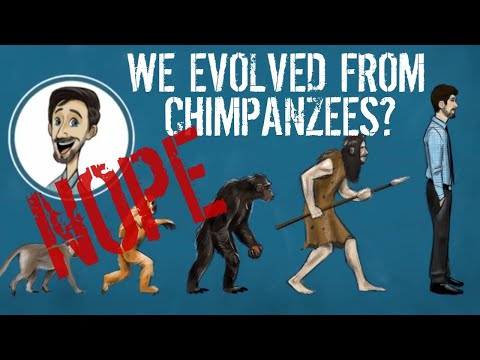
Chimpanzees and humans split off on different evolutionary paths millions of years ago. Evolution doesn’t mean one species just turns into another that already exists.
Instead, species branch out and adapt to their own environments.
Misconceptions About Linear Evolution
A lot of people imagine evolution as a ladder—chimps on one rung, humans on the next. But that’s not how it works.
Evolution is a tree, not a straight line. Branches split and twist in all directions.
Humans didn’t evolve from the chimpanzees you see now. Both species came from a shared ancestor about 6 or 7 million years ago.
Since then, humans and chimps have changed in their own ways. Chimps will keep being chimps; they’re not on a path to become human.
Thinking of evolution as always moving “forward” or “improving” species doesn’t really fit. Evolution means adapting to your environment, which leads to all sorts of results—not just becoming human.
If you want to dig into this, check out why chimpanzees aren’t evolving into humans.
How Evolution Works in Great Apes and Monkeys
Chimpanzees fit into the great apes, along with gorillas, orangutans, and humans. Monkeys are a totally separate group of primates.
All these animals have evolved traits to help them survive where they live. Evolution favors traits that boost survival and reproduction in each environment.
For chimpanzees, that means staying good at climbing, social hunting, and finding food in forests. Humans evolved to walk on two legs, think differently, and use language because those things helped your ancestors survive.
So, evolution is really about adapting to your surroundings. Since chimps and humans live in different ways and face different challenges, their evolution takes separate paths.
Insights From the Fossil Record and Ancient Human Species
Fossils reveal that many human species once walked the earth. You’ll find names like Homo erectus, Neanderthals, and Ardipithecus popping up in the record as branches of our family tree.
Over millions of years, these species changed in different ways. Eventually, those changes led to modern Homo sapiens—that’s us.
Chimpanzees don’t show up in this particular branch. They split off way earlier, following their own evolutionary path.
Their fossils and the chimps we see today tell a completely separate story. It’s a good reminder that our line and theirs have run alongside each other for a long time.
Humans never replaced chimpanzees. Both groups just kept evolving from a shared ancestor, side by side.
That’s why chimpanzees are still here, and why they’re not about to turn into humans. Makes you wonder what twists the story could’ve taken, right?
If you want to dig deeper into the fossil evidence and see how the different species branched out, check out studies on the fossil record and human evolution.


