
When you think of seahorses, maybe you imagine delicate creatures holding onto seaweed. But honestly, some seahorses get surprisingly big. The biggest seahorse ever recorded hit about 35–36 cm (around 13.8–14 inches). That’s huge for a seahorse—usually, it’s the big-belly or one of its giant relatives that takes the crown. That one fact really changes how you picture these odd fish.

Let’s get into which species grow that large, where they turn up, and why their sizes can be all over the place. You’ll get some easy comparisons and real-life examples, so you can spot the giants and the tiny ones.
The Biggest Seahorse Ever Recorded

Let’s talk about which seahorse species actually reach those giant sizes. Researchers measure big specimens in a few ways, and there’s even a recent find off the Dorset coast that’s worth mentioning.
Record-Breaking Individuals and Measurements
Scientists usually measure seahorse size from the top of the head to the tip of the tail.
The big-belly seahorse, Hippocampus abdominalis, holds the record—these can reach about 35 cm (13–14 inches).
Most big adults measure somewhere between 18 and 28 cm, but every so often, a monster shows up close to that 35 cm mark.
Some species barely hit 2 cm, so a seahorse over 30 cm is just wild.
It’s worth checking if a measurement was taken with the seahorse straight or curled, since that changes the numbers a lot.
Museum specimens or photos with a ruler and a clear observer note usually back up the best records.
Pacific Seahorse and Big-belly Seahorse Compared
The Pacific seahorse (Hippocampus ingens) and the big-belly seahorse (Hippocampus abdominalis) don’t really overlap in range or size.
You’ll find Hippocampus abdominalis around Australia and New Zealand, and it’s the true heavyweight—up to 35 cm.
Hippocampus ingens lives in the eastern Pacific.
It gets big, but not quite as massive as the big-belly.
The big-belly just looks chunkier, with a thicker body and a bigger head.
If you ever spot a large seahorse, check out its colors and body shape—those clues help experts tell them apart.
A field photo with a ruler or something familiar in the shot helps confirm what you saw.
Notable Sightings and Verification
Experts don’t just take someone’s word for a huge seahorse.
They want clear photos, exact measurements, and good notes from whoever spotted it.
Groups keep records—national seahorse databases log the size, place, date, and what kind of proof was collected.
A photo with a coin or ruler in the frame is gold for confirming length.
Getting the species right matters, too.
Misidentifying a seahorse can really mess up records, so specialists look at traits and where it was found.
If you ever report a big seahorse, add details like tide, depth, and how you handled or let it go.
That stuff helps verify the sighting and keeps the animal safe.
Fourth Largest Seahorse Incident
Someone found a huge seahorse off Poole Bay, Dorset, and it ended up as the fourth largest since 1994.
A father and son caught it by accident while crabbing, snapped a quick photo, then put it back in the water.
The Seahorse Trust logged the sighting in the National Seahorse Database.
They figured it was about 15–20 years old and looked super healthy.
Neil Garrick-Maidment from the Seahorse Trust pointed out the animal’s skin mucous and body markings as signs it was in great shape.
The Trust also reminds people that if you’re searching for seahorses on purpose, you might need a licence from the Marine Management Organisation.
If you find a big seahorse, take a fast photo, don’t keep it out of water long, and let expert groups know what you saw.
Seahorse Species and Size Diversity
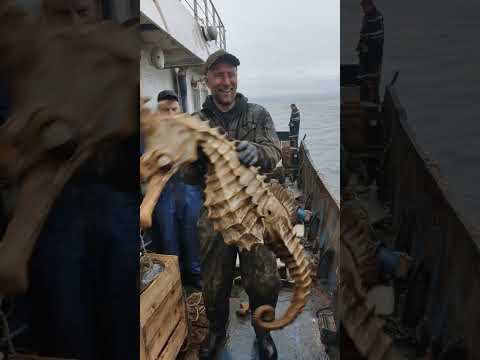
Seahorses come in all shapes and sizes, honestly.
Some barely reach 2 cm, while others top 30 cm or more.
Their size depends a lot on where they live, what they eat, and how they hide or find a mate.
Range of Sizes Among Seahorse Species
You’ll see everything from tiny reef seahorses to big ones in coastal waters.
The smallest adults measure just 1–2 cm.
The biggest hit 30–36 cm, from the tip of the snout down to the tip of the tail.
Usually, size matches the habitat.
Tiny pygmy seahorses stick to branching corals, blending in with polyps.
Larger species, like some from the Pacific or southern hemisphere, live in kelp beds, seagrass, or rocky shallows—having a long body helps them grab onto bigger stuff.
Size changes what they eat, too.
Small seahorses go for tiny copepods.
The bigger ones can hunt down shrimp and mysids.
Even within one species, you’ll find size differences depending on local food and water temperature.
Smallest and Pygmy Seahorses
You’ll find the tiniest seahorses—pygmy seahorses—right on coral branches.
Species like Hippocampus satomiae barely reach 1–2 cm.
They’re almost invisible, matching the coral’s texture and color.
These little guys have short snouts and compact bodies.
They eat tiny plankton and crustaceans, and their small size helps them dodge predators.
If you’re lucky enough to dive on a healthy reef, you might spot one clinging tight to a gorgonian or soft coral.
Key Features of the Largest Seahorses
The biggest seahorses have some pretty distinct traits that make them easy to spot. Species like the big-belly or pot-bellied seahorse, which live around Australia and New Zealand, can actually grow up to about 35 cm.
Some folks have reported other large types, like Pacific or giant seahorses, reaching nearly 36 cm. Their long snouts, sturdy trunks, and those powerful prehensile tails really stand out.
You’ll often see that large seahorses have more dorsal fin rays and wider tail rings. They also tend to show off thicker bony plates and bold color patterns—stripes or bands pop up in species like the tiger tail, lined seahorse, or even the spiny and great seahorses.
These markings help them blend into kelp, eelgrass, or rocky spots. If you dig through records and photos, you’ll notice Hippocampus comes and Hippocampus ingens often show up as some of the biggest seahorse species around.


