
Ever wondered just how smart a chimpanzee really is? You’re definitely not alone. These animals pull off some downright impressive problem-solving and tool-using feats, which leaves a lot of people curious about their brains.
When it comes to IQ, experts usually estimate that a typical chimp scores somewhere between 40 and 60. That’s about the same as a young child. It’s a rough comparison, but it gives us a sense of how their minds stack up against ours.
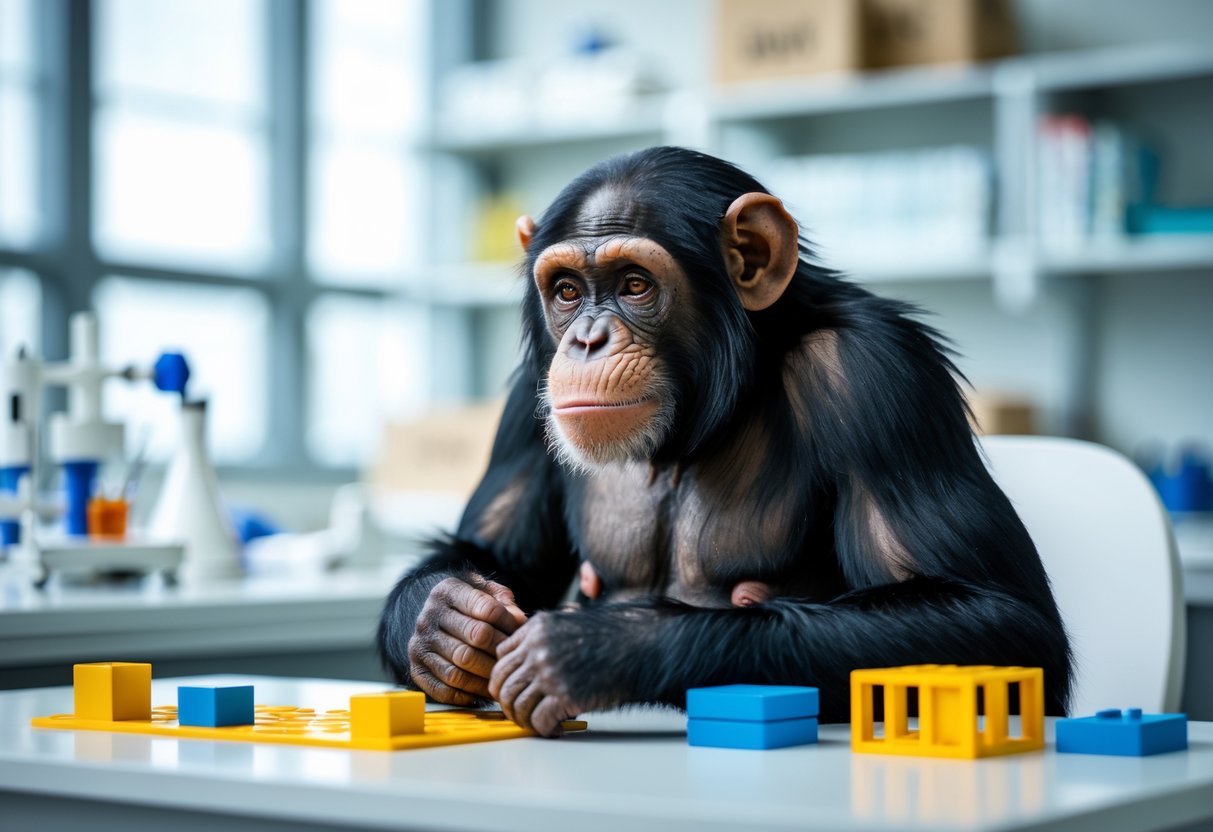
Chimps don’t really think like humans do, so measuring their IQ isn’t straightforward. They rely more on instinct and survival skills than on language or abstract logic.
You’ll notice their intelligence in the way they use sticks to get food or in how they communicate with each other. Their minds work differently, but they’re clever in their own right.
If you keep reading, you’ll see what shapes chimpanzee intelligence. Comparing their IQ to ours gets tricky, but it’s worth understanding. You might even find yourself surprised by how well their brains help them handle life in the wild.
For more details, check out this article on the average IQ of a chimpanzee.
IQ of a Chimpanzee: How Smart Are They?

Chimpanzees can be surprisingly sharp. They solve problems, use tools, and communicate in ways that really show off their mental skills.
Learning about their IQ gives us a peek at how their minds operate compared to ours. It’s honestly fascinating to study them.
Average Estimated IQ of a Chimpanzee
Scientists usually put a chimpanzee’s IQ somewhere between 35 and 60. This range means their intelligence is kind of like a human child around 3 or 4 years old.
Chimps plan ahead, grab sticks to get food, and pick up tricks just by watching others. These actions show they’re capable of problem-solving, remembering things, and learning from their group.
Since chimps don’t think like people, this IQ number is just a rough estimate. Researchers base it on things like brain size and how they handle certain tasks, not a direct IQ test.
Limitations of Applying Human IQ Tests to Chimpanzees
Human IQ tests focus on skills like language and math. Chimps just don’t use those skills the same way we do, so those tests can’t really measure their intelligence well.
Chimpanzees shine more in survival skills, social communication, and tool use. Human-style questions don’t capture those strengths.
So, if you see an IQ score for a chimp, treat it as a general idea. They’re smart in ways those tests just don’t pick up, like reading social cues or adjusting to changes in their world.
How Chimpanzee Intelligence Compares to Humans
Chimpanzee brains are smaller than ours, but that doesn’t stop them from being clever. Their average Encephalization Quotient (EQ) is about 2.35, which links brain size to body size. That lines up with an IQ score between 35 and 60 on the human scale.
Their mental abilities are similar to young children’s problem-solving and learning. That’s pretty impressive, honestly.
Chimps use gestures, facial expressions, and sounds to get messages across. They show real emotions and sometimes comfort each other.
This social and emotional intelligence adds another layer to their smartness. If you want more details, check out the estimated range at What is the IQ of a Chimpanzee? Understanding Primate Intelligence.
Key Aspects of Chimpanzee Intelligence

Chimpanzees show off their intelligence in all sorts of ways. They can tackle tricky problems, use tools in creative ways, and pick up on feelings and gestures. These skills help them survive and get along in different environments.
Problem-Solving Skills and Tool Use
When a chimp faces a challenge, it doesn’t just guess. You’ll often see them plan and figure things out.
For example, they grab sticks to fish termites out of mounds or use rocks to crack nuts. That shows they understand cause and effect.
Chimps will even change their tools to fit the job. They might strip leaves off a branch to make it better for fishing termites.
This kind of thinking means they don’t just copy—they adapt and invent. Their sharp memory helps them remember where to find tools or food.
Problem-solving and tool use really set them apart.
Social and Emotional Intelligence
Chimpanzees live in groups and depend on each other a lot. They’re great at reading feelings in others.
You’ll see them use facial expressions and gestures to show happiness, anger, or fear. Young chimps pick up skills by watching adults.
Social learning helps them figure out things like using tools or finding food. It also means each group can develop its own traditions.
Understanding others’ feelings helps chimps keep the peace. They comfort friends or notice when someone’s upset, which shows a deep social awareness.
Communication and Language Abilities
Chimpanzees don’t talk like we do, but honestly, they’ve got their own ways to get a point across. You’ll hear them make all sorts of sounds—hoots, grunts, even a high-pitched squeal now and then—to let others know what’s up or how they’re feeling.
They use gestures, too. Sometimes a chimp just throws up a hand, maybe asking for help, or pulls a face to show submission.
Sure, they don’t have words the way we do, but their messages come through loud and clear within their groups. This helps them cooperate, warn each other about trouble, and keep those social connections strong.
Their knack for using all these signals? It’s honestly pretty impressive and says a lot about how smart they are.
If you’re curious about how chimps think and learn, you might want to check out chimpanzee intelligence and problem-solving skills.


