
You might expect seahorses to swim like most fish, but honestly, they do their own thing. They keep upright and use a single dorsal fin to push themselves forward, while those tiny pectoral fins by their head help them steer and stay balanced.
This unique setup lets seahorses glide slowly and precisely through seagrass and coral. They give up speed for stealth, and it works for them.
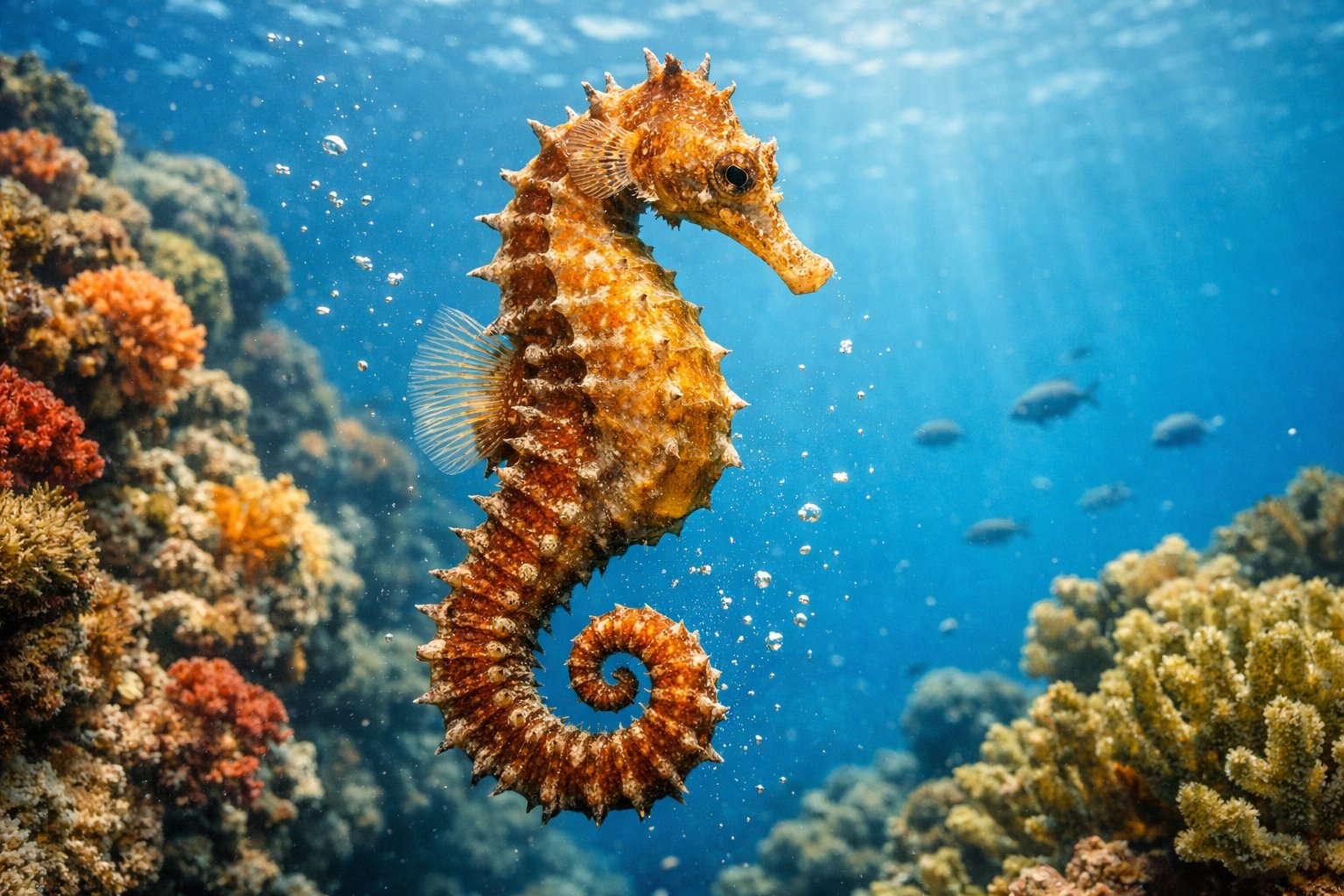
As you read on, you’ll see how the rapid dorsal fin and those precise little pectoral fins work together. Their body shape and family traits (Syngnathidae, if you want to get technical) also play a role in their swimming.
You’ll find out how these adaptations help them hide, hunt, and grab onto plants with their tails. The next sections break down the mechanics and the special features that make seahorse swimming so unusual.
Mechanics of Seahorse Swimming

Seahorses swim upright by using just a few fins and a stiff, armored body. They get their main push from one fin, while those tiny fins by the head steer and keep them steady.
The tail and bony plates also change how they float and move.
Upright Body Position and Propulsion
You’ll notice a seahorse holds itself almost vertical in the water. This comes from a body built with segmented bony plates, making the trunk rigid.
That armor stops them from bending side-to-side, so they can’t wiggle their bodies like most fish or even pipefish.
Since the body stays upright, the fins push them both forward and a bit upward. Their center of mass and swim bladder affect how they float, so they often end up with a little lift as they move.
The prehensile tail doesn’t help them swim; they use it to grab seagrass or coral while the dorsal fin does all the work.
Most seahorses don’t really have a proper tail fin, so the dorsal fin takes over for swimming. This makes them slow, but they get amazing control in thick habitats.
Role of Dorsal Fin in Movement
The dorsal fin runs along the back and beats super fast—sometimes 30 to 70 times a second in small species. Think of it as the seahorse’s engine, creating a wave that pushes water and moves them forward.
Because the dorsal fin moves up and down and a bit back and forth, it creates both thrust and lift. That’s why seahorses move slowly and can control their depth so well.
Researchers have tried to model how this fin moves, since it’s so different from other fish.
The dorsal fin’s size and how fast it beats set their cruising speed. Bigger fins or faster beats mean more thrust, but it also costs more energy.
So, there’s always a trade-off between how nimble they are and how long they can keep swimming.
Steering and Stability from Pectoral Fins
Tiny pectoral fins near the head work like little steering wheels and stabilizers. They don’t beat as hard as the dorsal fin, but they let the seahorse turn, roll, and make small adjustments.
When you want to aim at prey or dodge a current, you can change the angle of your pectoral fins to steer. They also help counteract the lift from the dorsal fin, letting you hold your spot.
The rigid bony plates and wide, flat head keep you from pitching too much.
Together, the pectoral fins and prehensile tail let you stay almost still or turn on a dime in seagrass. This helps with their sit-and-wait hunting style and lets them hover near prey.
If you’re curious about the science behind all this, check out this study on seahorse hydrodynamics (https://www.aip.org/scilights/exploring-the-unique-swimming-dynamics-of-seahorses).
Adaptations and Swimming Behavior

Seahorses use slow, low-energy movement, clever camouflage, and a strong grip to survive in seagrass beds, coral reefs, mangroves, and cooler coastal waters. Their shape, fins, and tail help them hold their ground, ambush tiny prey, and protect eggs in the male’s brood pouch.
Energy Efficiency and Slow Movement
Seahorses move slowly, beating a tiny dorsal fin really fast but not going far. That dorsal fin can flutter up to 30 times per second in some species, giving steady but gentle thrust.
The pectoral fins near their head steer and stabilize them, letting them make quick turns if, say, a shrimp drifts by.
Moving slowly saves energy, which matters when you live in places with strong currents or not much food, like estuaries and seagrass meadows. Seahorses often anchor themselves to a blade of seagrass or coral with their tail, so they don’t have to fight the current.
Hippocampus zosterae, the dwarf seahorse, moves especially slowly. Other types, like the Pacific seahorse or big-belly seahorse, also trade speed for better stability.
Camouflage and Ambush Predation Strategies
Seahorses depend on camouflage and patience to catch tiny crustaceans. They can change color and texture to blend in with seagrass, coral, or mangrove roots, so prey doesn’t even notice them.
They hover upright, waiting for the right moment, then suck prey in through their tube-like snout with a quick snap.
Some seahorse species form monogamous pairs, which helps them hunt together and defend their territory. The male’s brood pouch lets him carry eggs until they hatch, so both parents can stay anchored and feed while protecting their young.
Unfortunately, overfishing and accidental capture threaten many seahorse species. That makes their careful use of habitat and camouflage even more critical for survival.
Unique Body Features Across Seahorse Species
You’re part of the Syngnathidae family, which includes pipefish and seadragons. Your shape shifts depending on the species, adapting to habitat needs.
Pygmy seahorses? They’re tiny and cling to gorgonians, blending in with those intricate coral textures. The big-belly seahorse has a bulkier body and a larger brood pouch—makes sense, since it needs to carry lots of eggs.
The Pacific seahorse grows bigger and probably deals with different predators along open reef edges. That’s just the way things go in the wild.
You rely on bony plates instead of scales, a prehensile tail for grabbing onto things, and a tubular mouth. Males have a brood pouch, which is kind of fascinating.
These features let each seahorse species find its own niche, whether it’s in shallow seagrass beds or deeper coral reefs. Sure, they aren’t great swimmers, but they make up for it by being sneaky ambush predators.


