
You’d think animals that flip parenting roles are rare, right? But seahorses really shake up that idea. Yep — male seahorses actually carry and give birth to their young. They do more than just hold the eggs; dads protect and nourish embryos before birth.
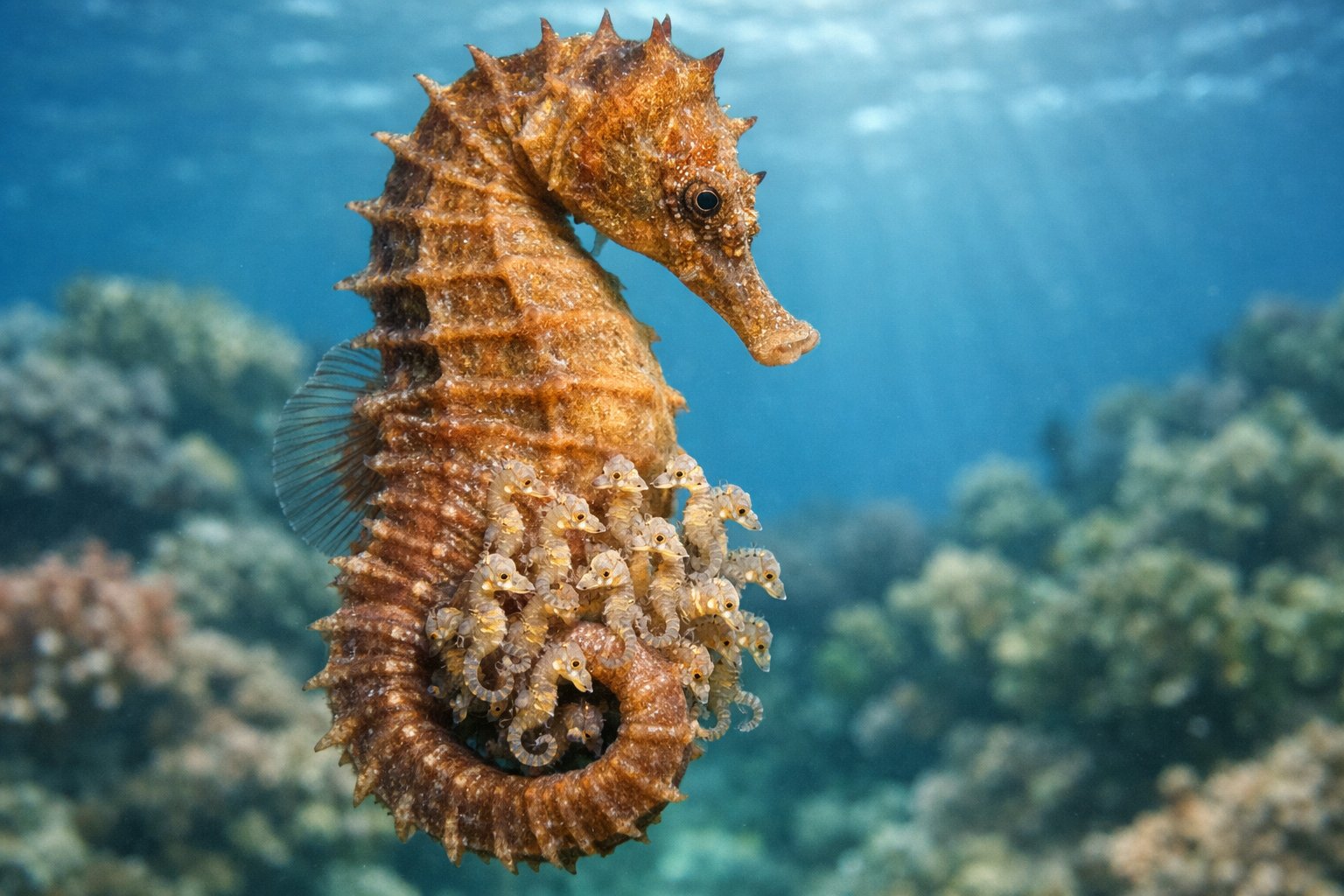
You’ll see how dads carry babies in a pouch, how the birth happens, and what goes on after the fry swim off. There’s a lot happening behind the scenes—behaviors and biology that might just challenge what you expect about animal parenting.
Curious about how a dad ends up pregnant and what he actually does before and after birth? Let’s look at the pouch, the birth, and what seahorse fathers do once the babies are out in the world.
How Seahorse Dads Carry and Birth Their Babies

Male seahorses carry eggs in a pouch, care for embryos, control the pouch’s environment, and use their bodies to release the young when it’s time.
The Brood Pouch: Nature’s Nursery
The brood pouch sits on the male’s tail. It’s a sealed chamber where eggs rest after transfer.
The pouch wall grows a lining that provides oxygen and nutrients to the embryos. It acts a bit like a placenta and helps control salt levels inside.
Pouch size and shape depend on the species. Pot-bellied seahorses have roomy pouches, while dwarf seahorses have smaller, snug ones.
The pouch opening can close up, keeping babies safe from predators and parasites.
During courtship, you can spot the pouch changing. Males fill the pouch with water, then with eggs and sperm.
As embryos grow, the pouch swells up. The male’s body keeps things stable in there until birth.
Egg Transfer and Fertilization
During mating, the female uses her ovipositor to put eggs straight into the male’s pouch.
The pair lock tails and do a little courtship dance. This dance helps with timing and seems to sync up their bodies.
Once eggs are inside, the male releases sperm and fertilizes them right in the pouch. Fertilization happens pretty fast—just seconds or minutes.
He seals the pouch after, keeping the embryos safe from outside water and germs.
Species matter here. Big seahorses might get hundreds or even thousands of eggs. Dwarf seahorses carry way fewer.
After the transfer, the male pumps water and adjusts pouch fluid to keep the embryos healthy.
Pregnancy and Embryo Development
Embryos loosely attach to the pouch lining. The male provides oxygen and some nutrients through blood vessels in the pouch wall.
This exchange helps embryos grow organs, tails, and skin before birth.
Hormones play a role in how the pouch works. Some are similar to those in mammal pregnancy, though the pouch doesn’t have as much smooth muscle as a uterus.
Isotocin-like hormones might trigger pouch changes and behaviors.
A pregnant male often changes color and size. The pouch gets bigger and sometimes darker.
Embryos develop over weeks, depending on water temperature and species. Cooler water slows things down; warmer water speeds it up.
The Birth Process: How Seahorse Dads Deliver
Birth starts when the male contracts his body in strong, rhythmic movements. He bends, presses his tail, opens the pouch a bit, and gives quick jerks.
Each jerk shoots out groups of baby seahorses into the water.
Seahorse dads use skeletal muscles and nearby bones to open the pouch. These muscles work with the body’s movements, not like the smooth muscle contractions in mammals.
Water flushes through the pouch while the young come out, helping push them along.
Depending on the species, a litter can have dozens or even over a thousand babies. They come out fully formed and ready to go.
The whole birthing process might take minutes or hours, with the dad resting briefly between contractions.
Do Seahorse Fathers Care for Their Young After Birth?

Male seahorses carry embryos in a pouch and give birth to fully formed young. But after birth, the tiny seahorses swim out and get no help from either parent.
What Happens To Baby Seahorses After Birth?
When a male expels his brood, hundreds of tiny seahorse babies pour out over a few minutes. Each one looks like a mini adult, already able to swim, hunt for tiny plankton, and grab onto seagrass with its tail.
They have to feed on small crustaceans and handle currents right away. The father’s pouch gave them oxygen, nutrients, and a steady salt balance, but it doesn’t teach them how to hunt or offer shelter once they leave.
Most babies don’t make it. Many get swept away from seagrass beds or eaten by fish and crabs within days.
Parental Care in Seahorses vs. Other Fish
Seahorses put a lot of effort into prenatal care. The male’s pouch regulates oxygen, fluid, and maybe even provides nutrients.
That’s pretty different from most fish, which usually just scatter eggs or stick them to something and move on.
After birth, seahorses behave more like broadcast or egg-scattering fish. They don’t feed, guard, or transport their young.
Some fish, like cichlids or sticklebacks, will guard and feed their young, but seahorses don’t do that.
Brood size and pouch complexity change with species, which affects how well embryos develop before birth. But no matter the species, once babies leave the pouch, parental care ends.
Survival Challenges for Seahorse Offspring
Honestly, your odds of making it to adulthood are pretty dismal—usually less than 1 in 200. Fish, shrimp, and all sorts of hungry predators take out a lot of newborns almost immediately.
Currents play a huge role too. If you drift away from seagrass beds, you suddenly lose both shelter and easy access to plankton.
Habitat loss makes things even tougher. When seagrass disappears, so do the safe places and food sources young seahorses need.
Since adults don’t stick around to feed their babies, everything depends on the eggs and the pouch. Good nutrition inside that pouch and plenty of healthy seagrass nearby can make a real difference.
If you’re lucky, you’ll find enough food and a place to hide—but luck doesn’t always last long out there.


