
It sounds wild, but male seahorses really do carry and give birth to their babies. The female drops her eggs into the male’s brood pouch, and he fertilizes, carries, and eventually releases dozens—sometimes hundreds—of tiny, fully formed young.
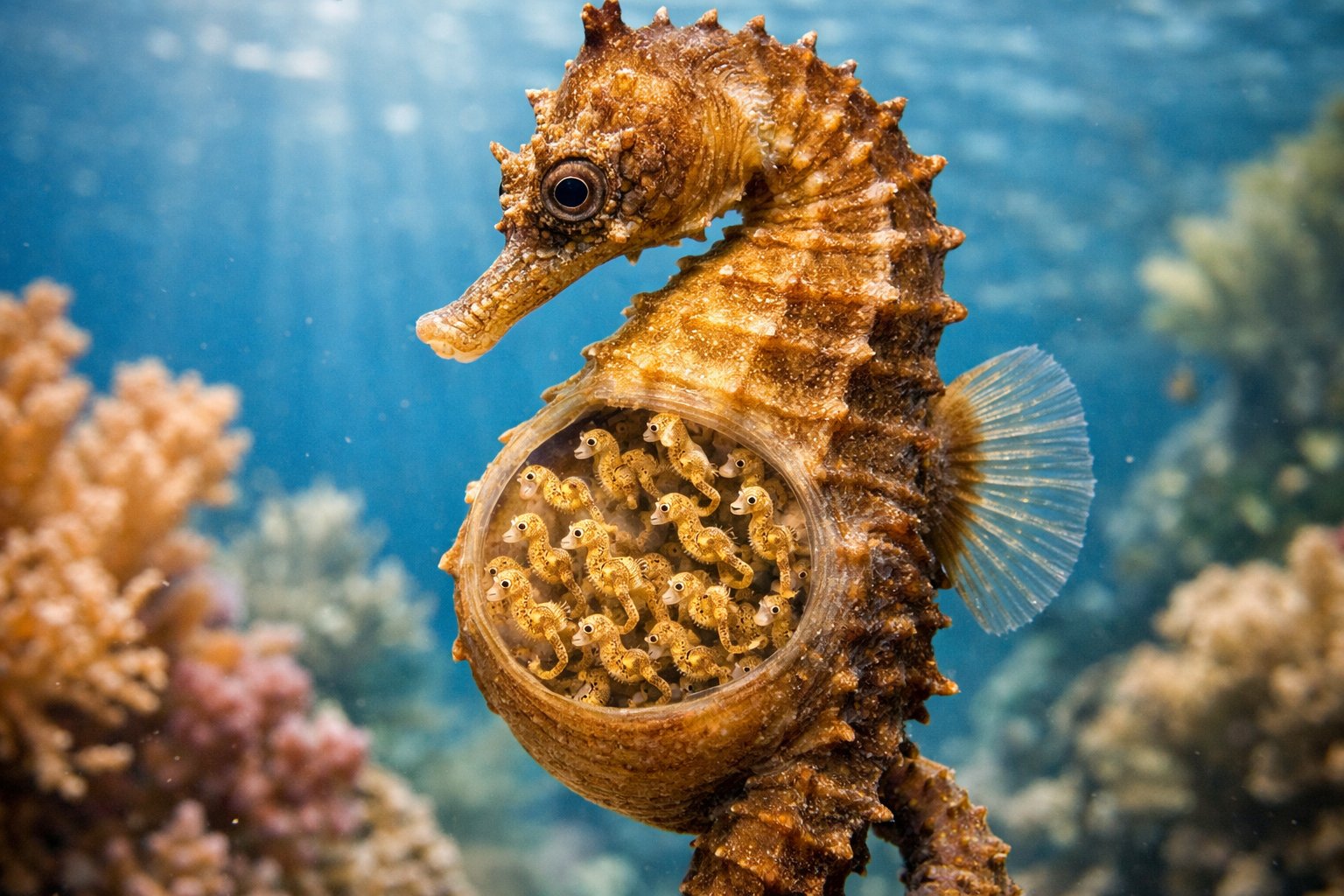
So, how does that pouch actually work? Why do the males take on pregnancy? And what weird body parts and behaviors help them pull off this whole baby-carrying act?
There’s a lot to unpack here, including how seahorse family life compares to their close relatives, and why this parental role swap helps them survive.
How Male Seahorses Carry and Give Birth

Male seahorses use a pouch on their tail to carry eggs, protect and nourish embryos, and then—through some impressive body movements—push out the fully formed babies. First, the female transfers her eggs, the male fertilizes and incubates them, and finally, he goes through a pretty active labor that launches a crowd of fry into the water.
Male Pregnancy in Seahorses
In the Syngnathidae family (genus Hippocampus), the female transfers eggs into the male’s brood pouch. The courtship between pairs can actually last days, which helps them get the timing right and sync up physically.
The female uses her ovipositor to place eggs straight into the pouch opening. Once the eggs are inside, the male fertilizes them by releasing sperm at the rim of the pouch.
Pregnancy lasts several weeks, depending on species and water temperature. During this time, the male supplies oxygen and nutrients and keeps the pouch environment stable. This makes seahorse dads stand out among animals—Britannica and National Geographic both highlight this rare trait.
How the Brood Pouch Works
The brood pouch sits on the male’s tail and acts like a nursery. Inside, tissue forms something a bit like a placenta, allowing embryos to absorb oxygen and some nutrients from dad’s blood.
The pouch also keeps salt levels balanced and shields the embryos from predators and parasites.
Picture the pouch as a tiny sealed chamber that the male can flush with seawater. Tissue folds and a closing valve at the opening hold the embryos safely during development.
Researchers have found the pouch doesn’t have much smooth muscle and instead relies on a blend of tissues to support the developing young.
Egg Transfer and Fertilization
During transfer, the female lines up her ovipositor with the male’s pouch opening, and both parents anchor themselves with their tails. She deposits dozens—or sometimes hundreds—of sticky eggs into the pouch in just one go.
Right after, the male releases sperm across the eggs’ surface to fertilize them.
Fertilization inside the pouch cuts down on egg predation and boosts the odds of survival. The pouch lining also releases fluids that help the embryos grow.
Timing, courtship, and even the physical fit between seahorse pairs all affect how many eggs get successfully transferred.
Birth: The Unique Labor Process
When the babies are ready, the male starts a series of movements to push them out. Unlike mammals, who use smooth muscle contractions, the seahorse dad relies on big skeletal muscles near the pouch and whole-body twisting to open the pouch and force out the fry.
These jerks and squeezes let seawater rush in and sweep out groups of tiny seahorses.
Birth can take anywhere from a few minutes to a couple of hours, and a single dad might release a handful or several hundred babies.
He seems to control the timing to give his young a better shot at survival. Some studies suggest hormones similar to oxytocin—called isotocin in fish—trigger these birth behaviors.
Seahorse Family, Adaptations, and Close Relatives

Let’s look at which seahorse species are most common, how their bodies help them survive, and what their close relatives have in common.
Seahorse Species and Their Characteristics
Seahorses fall under the genus Hippocampus. There are about 46 species, ranging from tiny—less than 2.5 cm—to big ones close to 30 cm long.
You’ll find all sorts of colors and patterns, usually matching the local seagrass, mangroves, or coral.
Most seahorses have a prehensile tail to grip onto things so they don’t drift away. Their bodies are armored with bony plates instead of scales.
Take the pot-bellied seahorse, for example—it’s got a rounded belly and a short snout. You’ll notice differences in snout length, tail shape, and brood pouch style, depending on the species. These features influence their diet and hiding spots.
Breeding habits can vary a lot. Some pair up for life and do daily “dances” before mating.
Brood sizes are all over the place, too—from a few dozen eggs to well over a thousand, depending on species and pouch size.
Relatives: Pipefish and Sea Dragons
Seahorses belong to the Syngnathidae family, which also includes pipefish and sea dragons. Pipefish look like stretched-out, skinny seahorses and usually don’t have much of a prehensile tail.
You might spot them wrapping their bodies around plants rather than coiling a tail.
Sea dragons (and seadragons) are flashier cousins with leafy appendages for camouflage. They don’t have a full pouch like some seahorses.
Instead, the males carry eggs on a brood patch under the tail or along the abdomen. Across the family, the big twist is that males end up carrying the eggs until they hatch.
Getting to know these relatives makes it easier to see how male pregnancy evolved. Different body shapes in Syngnathidae show the steps from simple egg-carrying to a fully enclosed pouch.
Physical Adaptations for Reproduction and Survival
Seahorses have picked up some pretty clever adaptations for both reproduction and survival. The male’s brood pouch gives developing embryos oxygen, helps balance salt, and provides nutrients.
When males give birth, they contract their bodies and push out fully formed young. The babies are ready to swim almost immediately, which is honestly pretty wild if you think about it.
Seahorses use their tube-like snouts to suck up tiny crustaceans and plankton. Their prehensile tails let them cling tightly to plants, especially when the water’s moving or during courtship.
Bony plates cover their bodies and help keep predators at bay, though these plates make them less flexible. Because of that, seahorses rely on camouflage and slow, careful movements to hunt and hide.
Their reproductive timing connects closely to these physical traits. Since males carry the young, females can produce new eggs more quickly while the dads are busy brooding.
This split in duties can boost the number of babies they have each season, though it really depends on things like food and how good the habitat is.


