
It’s easy to picture giraffes just grazing and staring off into the distance, but of course, they mate too—and honestly, their courtship is a bit stranger than you might think. Giraffes rely on scent cues and a careful ritual where males check a female’s fertility before trying to mount. That’s one reason their breeding stays slow, and why every calf really counts.

As you read on, you’ll see how males spot receptive females, what the actual mating looks like, and why giraffe pregnancies drag on for so long. There’s also a look at how calves come into the world and why their first months are so risky—honestly, it makes you realize why conservation is such a big deal.
How Do Giraffes Mate?

Giraffe mating isn’t exactly graceful. Males check for fertility and, when the moment is right, the actual act is pretty short and awkward. They use scent and watch behavior to find a female who might be ready, and sometimes they even fight for the chance.
Mating Behavior and Courtship
When a male senses a female might be fertile, he’ll start following her around. He often nudges her to urinate, then smells the urine to pick up chemical cues about her reproductive state.
That sniff test, called flehmen behavior, helps him figure out if mating will likely work. It’s kind of weird, but it’s pretty effective.
Courtship can be quick or drag on for hours. The male might nudge her, hang out nearby, and wait until she finally stops moving.
If she accepts him, the mating itself is fast. He mounts from behind and has to balance carefully—giraffes aren’t exactly built for this. You could spot this any time of year, dry season or wet.
Mate Selection and Female Choice
Females don’t just go along with any male. They show if they’re interested by their posture and by letting a male get close. Dominant males usually win after competing, but a female can still say no.
Males use their strength and scent-marking to compete. The younger guys usually don’t get much action—older, stronger males dominate.
Females reach sexual maturity at about four to five years old. Males don’t usually succeed until they’re bigger and older. That slow pace really shapes how giraffe populations recover.
Curious about more details? Check out how giraffes mate on Save Giraffes Now (https://savegiraffesnow.org/how-do-giraffes-mate/).
Giraffe Pregnancy and Calves
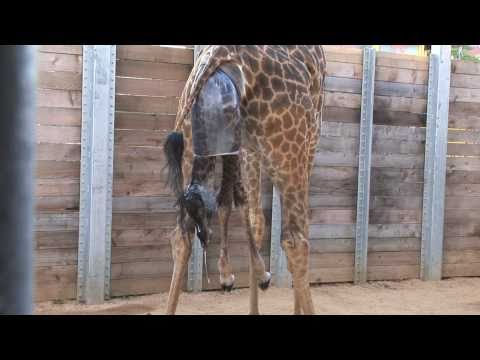
Let’s talk about giraffe pregnancies—how long they last, what birth looks like, and how calves actually make it through those first tough months.
Gestation Period and Birth
A female giraffe carries her calf for about 15 months, or roughly 453–464 days. That’s a long haul, but it gives the calf time to grow those long legs and big body.
Almost always, there’s just one calf. Twins are really rare.
When labor starts, the mother usually stays standing to give birth. The newborn drops about five feet to the ground.
That fall? It actually helps break the umbilical cord and gets the calf to take its first breaths. Newborns are surprisingly big—about 50–100 kg (110–220 lbs) and around 1.7–2 meters tall.
Mothers usually pick a quiet spot and might even leave the herd to give birth alone. You’ll see her clean the calf, licking it to get circulation going and to bond.
That first milk, colostrum, gives the calf vital antibodies.
Calf Development and Early Life
Calves usually try to stand within an hour after birth. Most manage to nurse not long after.
Early mobility really matters—predators like lions or hyenas often look for young giraffes. It’s a tough start.
For the first few weeks, mothers hide their calves in thick vegetation during the day. The calf spends a lot of time alone but comes back to nurse several times a day.
Over a few months, calves start learning to follow their mothers. Eventually, they join nursery groups where a handful of calves feed and rest together.
By six to twelve months, calves grow quickly. They still need milk, but they also start nibbling on leaves.
Weaning usually happens around twelve to eighteen months. A calf’s chances of making it depend on good habitat, mom’s protection, and avoiding human dangers like snares or vehicles.
If you want more detail about giraffe births and how calves behave early on, check out this page on giraffe reproduction and birth.


